About the Cell Tower Project
The TSRA Board is advancing a proposal to construct a 155 to 175 foot industrial telecommunication tower near the Dog Park off Deer Trail. This page summarizes what the project is, where it would be located, why it’s being pursued, and what concerns community members have raised.
What’s Being Proposed?
The Infrastructure
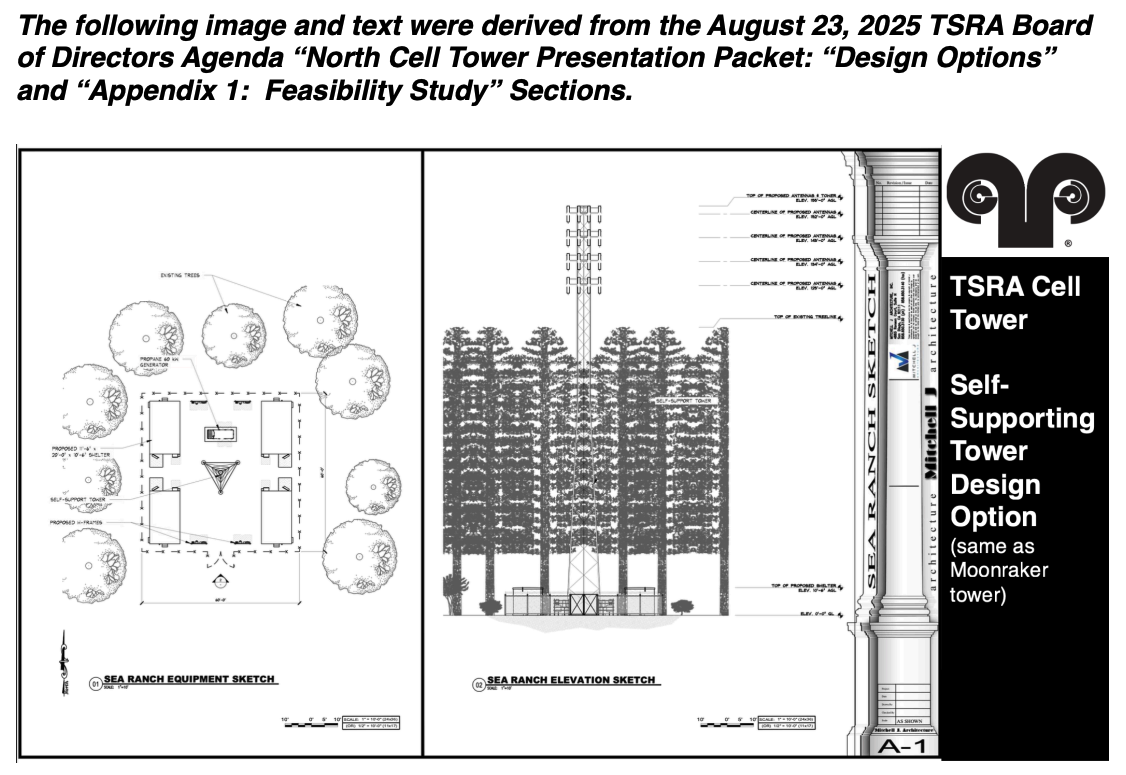
155-foot galvanized steel tower with plans for an extension up to 175 feet (approximately 80 ft-100 ft above the tree line)
Up to 48 antennas (4 carriers × 12 antenna panels each)
60 kW generator, required to run once per week for 15 minutes for maintenance
3,600 sq ft fenced enclosure topped with barbed wire
Up to 4 building structures to host networking equipment
Proposed expansion to hyperscale data center developers for additional revenue opportunities
The Location
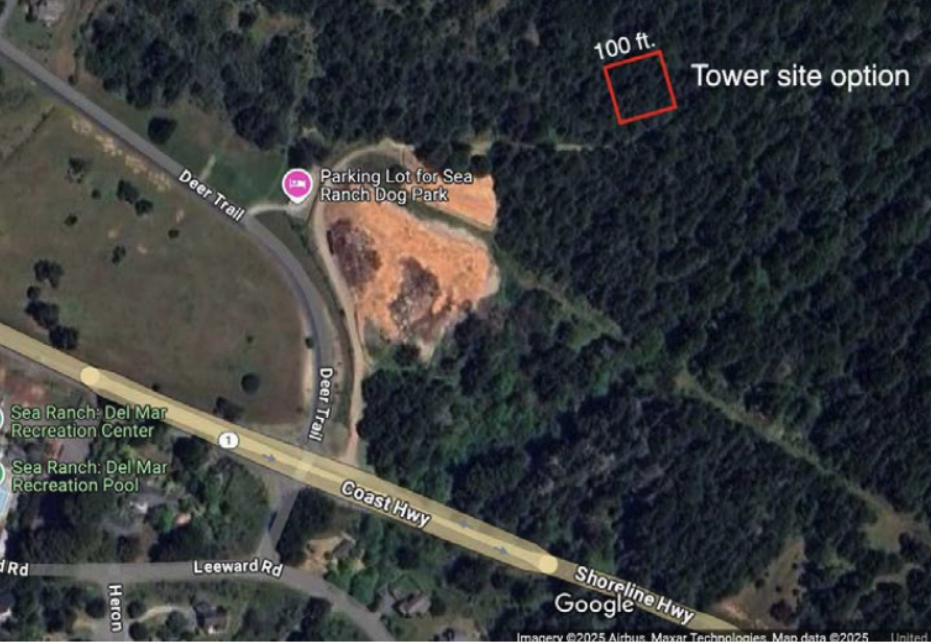
The location under study is on TSRA-owned common land near:
The Dog Park off Deer Trail
Adjacent residential neighborhoods
Close to trails, meadows, and Highway 1
Within the viewshed of Del Mar Center and surrounding homes
Why is the Board Pursuing This?
(Conclusions based on Board statements, committee meetings, and provided in member communications.)
Cell Coverage in the North End
In June 2025 Chair Fulkerson outlined the Board’s primary rationale for the project as “…a significant number of TSR homes on the North end have little to no cell coverage. This is not only an important safety issue, it is also a basic service that most of us have come to expect.”
Homeowners have repeatedly asked the Board for answers to three questions: How many members have little or no cell service? Whereabouts are these members’ homes located? Will this tower benefit their locations? To date the Board has not provided clear answers, because the project seems to have very little to do with these questions. It appears it has more to do with chasing what the corporate cell carriers will pay for.
Because of this information vacuum, members conducted their own practical assessments of coverage in the north end of The Sea Ranch. Figure 1 shows the areas in the north end covered by; 1) the Moonraker Tower (Cell 12 PCI 234) located at the southern end of The Sea Ranch; 2) the “Big Gulch Tower” (Cell 38 PCI 236) located north of the Gualala town center; and 3) the “Pico” antenna (Cell 18 PCI 234) located near the Gualala town center. The map shows coverage along the entirety of the northern portion of The Sea Ranch.
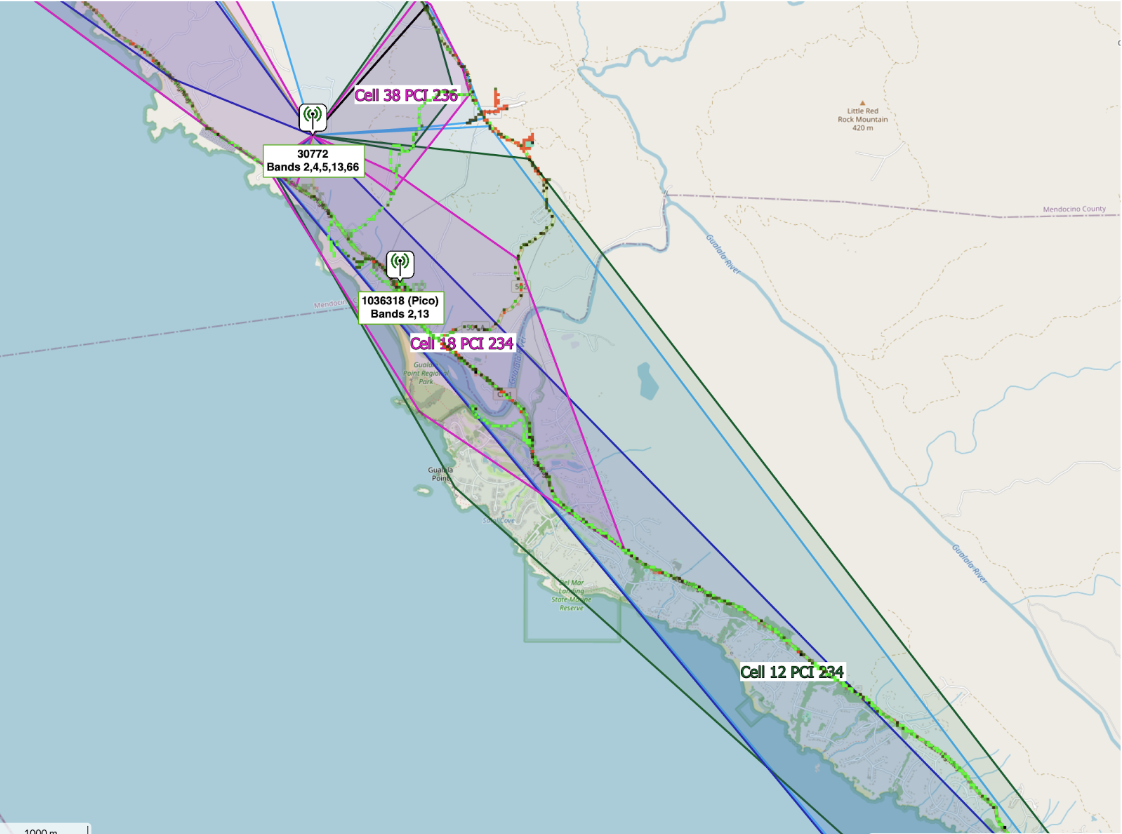
Figure 1. Map of the north end of The Sea Ranch showing cell coverage areas from Moonraker Tower (Cell 12 PCI 234), a small “Pico” antenna (Cell 18 PCI 234) in the middle of Gualala, and Big Gulch Tower (Cell 38 PCI 236) north of the Gualala town center. SOURCE: cellmapper.net
To test the accuracy of the map’s coverage, five different homeowners using Verizon, AT&T, and Consumer Cellular phone plans canvassed the north end making calls in many locations on the east and west sides of Highway 1, including Gualala Point Regional Park. One person with Verizon explored every Sea Ranch street and cul-de-sac in the north end.
On the east side this included all cross streets and cul-de-sacs from Deer Trail at Highway 1 to its terminus near the entrance to the reservoir. On the west side this included all cross streets and cul-de-sacs from the end of Leeward at the Gualala Point Regional Park boundary to Leeward Spur. Test calls and video conferences were made on the main streets Leeward and Deer Trail; at each cross street of those major streets; at the middle of longer cross streets and at their cul-de-sac endpoints; and at the end of short cul-de-sac cross streets. All calls were successful and there were no dead spots.
The Board’s statement of the rationale for a new cell tower misrepresents the situation on the ground regarding cell phone service. Their claim that a “significant number” of The Sea Ranch homes on the north end have little to no cell coverage is, at best, vastly overstated and, at worse, erroneous. Largely because of the addition of the “Big Gulch” tower in Gualala, on-the-ground field tests indicate that phone coverage throughout the northern end of The Sea Ranch already exists. This appears to be the same with the so-called Highway 1 “dead spot” between The Sea Ranch and Gualala.
Safety
In June 2025, Chair Fulkerson proposed another reason to justify the need for a cell tower in the north end: “…it can be a safety issue for anyone who has an emergency. It impacts our firefighters’ ability to effectively respond to fires and emergencies on the north end. If they don’t have cell coverage, that means they are often unable to effectively communicate with other neighboring fire departments and emergency services.”
Figure 1 below displays the 2025 CAL FIRE Fire Hazard Severity Risk Map for the North Sonoma Coast Fire Protection District (NSCFPD). Starting from the coast near Gualala, the northern two-thirds of The Sea Ranch generally has the lower fire hazard risk. Risk ratings mostly are “Moderate” (yellow) for the majority of the area west of Highway One. There are also areas on the eastside that are “Moderate” with the remaining areas “High” (light orange). The remaining one-third of The Sea Ranch at the south end tends toward a higher fire risk. Most of the area on the east side of Highway One at the south end is “Very High” risk (dark red). The west side is mostly a combination of “Moderate” and “High” hazard risk.
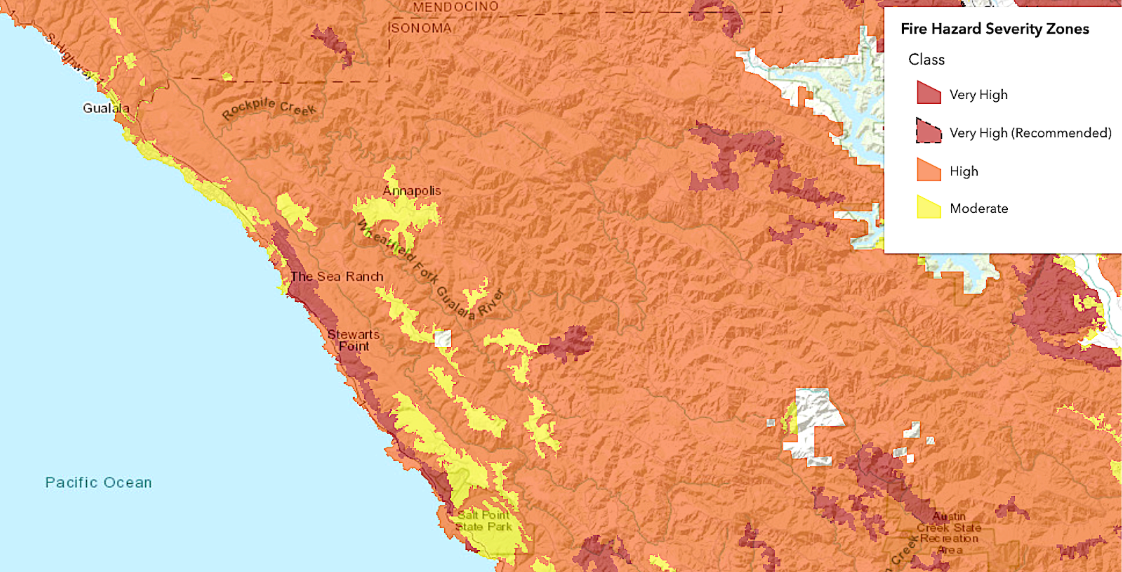
Figure 1. 2025 CAL FIRE Fire Hazard Severity Zones Map. SOURCE: https://www.arcgis.com/apps/Styler/index.html?
In October 2025 a public information request was made to the NSCFPD (Figure 2 – District boundaries) requesting incident or safety reports that documented poor cellular service in the North Sea Ranch area as a factor in effective emergency response. The District confirmed that have been no written reports of problems with cell service.
There was a recognition that “…there are indeed places with no service…. Although the lack of cell service is of concern, our focus is more on radio access. We do have a lack of radio communication at the northeastern part of TSR and Gualala Point Park east of Highway One, particularly with CAL FIRE’s dispatch center” (11/18/2025 NSCFPD email response to public records request). CAL FIRE has command of all vegetation fires in the District. There are many areas that require relaying radio communications a distance away from the incident to the dispatch center in Saint Helena. CAL FIRE personnel also confirmed that this is a problem, less so for the coastal region where radio coverage is considered “fair,” and more so east of The Sea Ranch where coverage is considered “poor” (June 2025 interview).
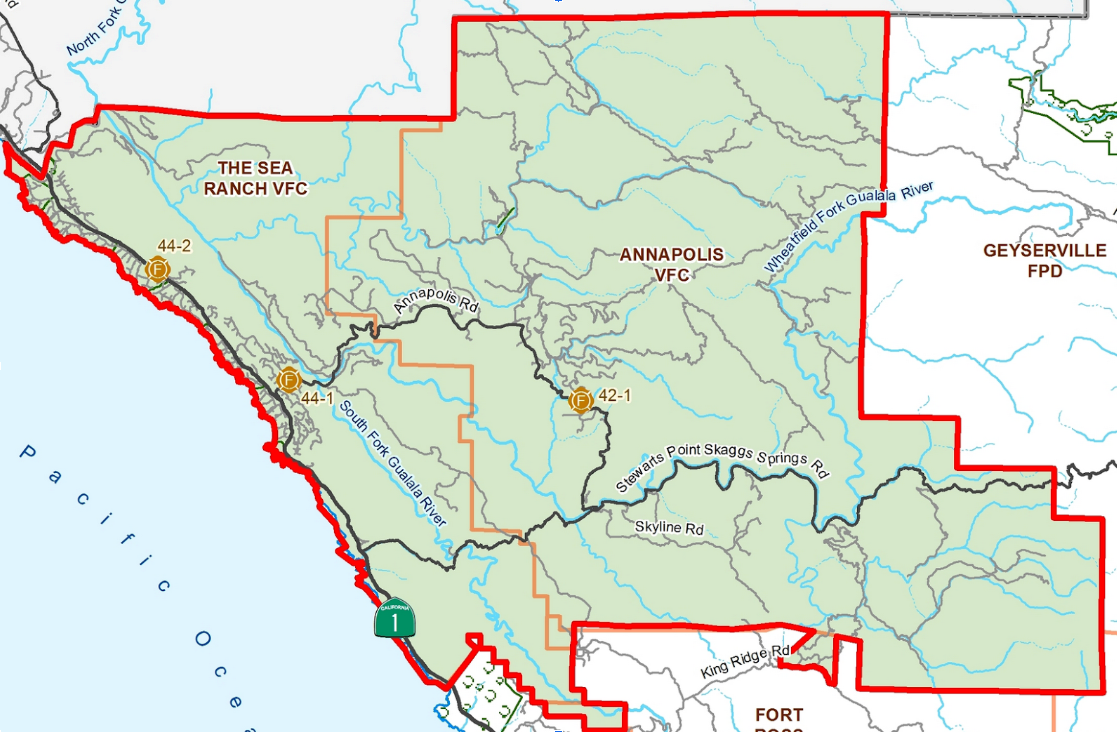
Figure 2. North Sonoma Coast Fire Protection District Boundary Map. SOURCE: https://www.northsonomacoastfpd.org/district-map/ - accessed November 19, 2025.
Figure 3 below is a topographical map showing the ridge of mountains (in yellow and green) separating Highway One on the west, from the Gualala River on the east, in the northeastern portion of The Sea Ranch. Yellow indicates higher elevation.
There is a ridge that runs the length of The Sea Ranch with its highest point near the Moonraker tower (787 ft.), and its second-highest point approximately one mile southeast of the proposed Dog Park site (679 ft.). The ridge gradually increases in height across the Gualala River and reaches its maximum height of 1,365 feet at the northern-most intersection of Roseman Creek Road and Iversen Road (not shown).
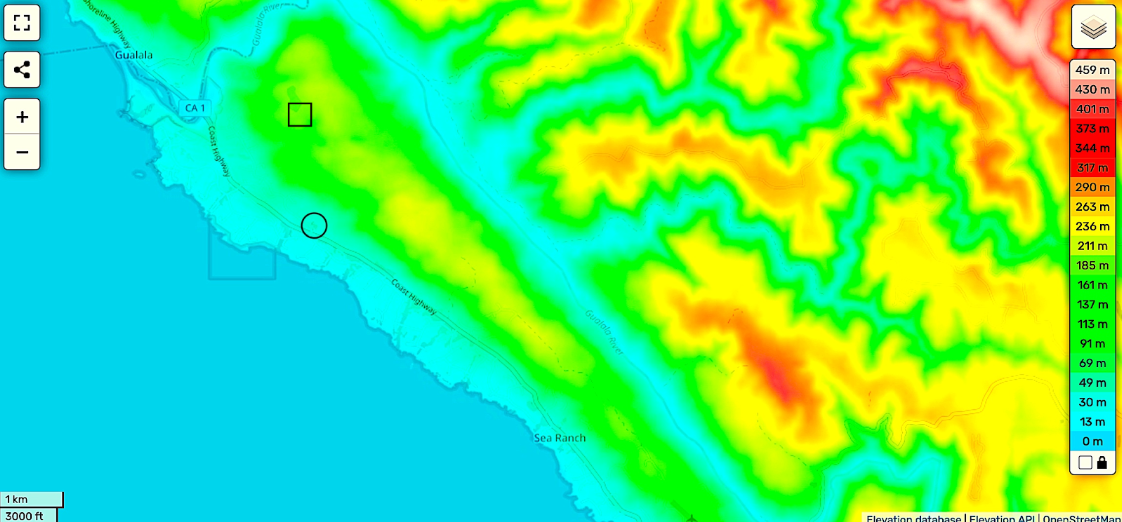
Figure 3. Topographical Map of The Sea Ranch from The Sea Ranch Airport to the Gualala River Showing the Relative Location of the Dog Park (circle) and Reservoir (square) Sites. SOURCE:
https://en-gb.topographic-map.com/map-klqm2/Sonoma-County/?center=38.75709%2C-123.48197&zoom=16&popup=38.72382%2C-123.49873
The black circle on the map is the location of the proposed Dog Park cell tower site, and the black square is the location of The Sea Ranch Reservoir cell tower site. The Dog Park site elevation is roughly 129 feet above sea level, while the Reservoir is approximately 528 feet above sea level. The addition of a 155-foot tower would bring the total tower height to 284 feet at the Dog Park, and 683 feet at the Reservoir.
Figure 4 below displays an enlargement of the environs of the Dog Park/Reservoir area. The numbers in red indicate the relative elevations above sea level along sections of the ridge that traverses this region. The average height of the ridgetop in the area from the Dog Park to the Gualala River is 585 feet. It is arguably the primary challenge, for both cell and emergency radio signal transmission in the northeastern part of the District, as the ridge is a significant line-of-site obstruction.
The L-shaped outline and numbers in magenta show the expanse and heights of sections of the ridge that are slightly below and slightly above the line-of-sight height of a tower if sited at the Dog Park (284 ft.). The rectangular area and numbers in blue show the expanse and heights of sections of the ridge that are below the line-of-sight height of a cell tower if sited at The Sea Ranch Reservoir (683 ft).
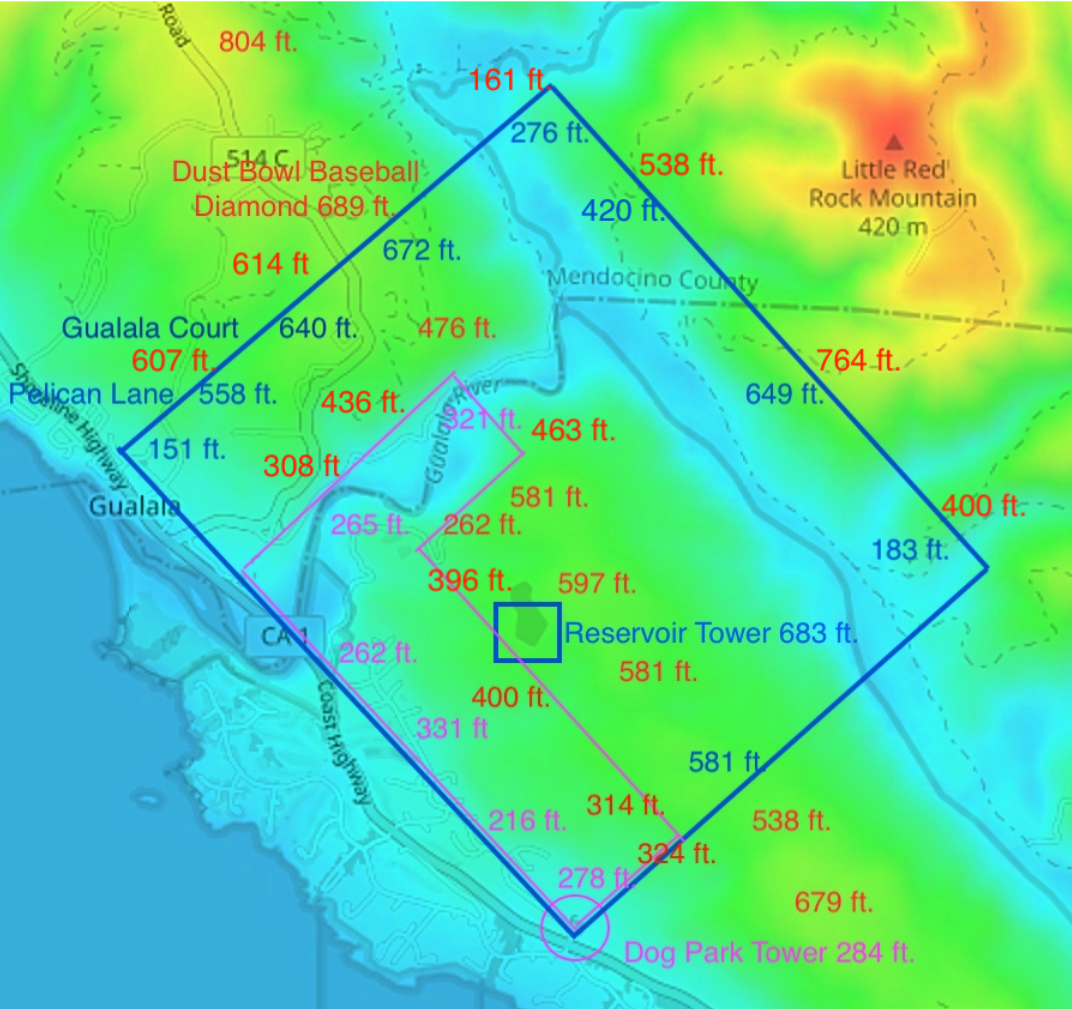
Figure 4. Topographical Map of the North End of The Sea Ranch Showing the Dog Park (Pink Circle) and Reservoir (Blue Square) Tower Sites and Line-of-Site Ridge Elevation Obstructions. SOURCE:
https://en-gb.topographic-map.com/map-klqm2/Sonoma-County/?center=38.75709%2C-123.48197&zoom=16&popup=38.72382%2C-123.49873
A tower at the Dog Park site located at the base of the ridge, is 301 feet lower than the average height of the ridge. It is likely the tower would struggle to provide reliable cell and emergency radio coverage on the northeastern side of The Sea Ranch due to substantial line-of-sight barriers. A tower at the Reservoir site located at the base of the ridge is 98 feet higher than the obstructing ridge. It would likely provide significantly more robust and reliable cell and emergency responder radio coverage considering the substantial reduction in line-of-sight obstacles.
In partnership with CAL FIRE, District firefighters also respond to mutual assistance calls from sister districts in eastern and southern Sonoma County, southern Mendocino County, and beyond. This is a large area encompassing hundreds of square miles, most of which consists of remote and rugged mountainous terrain with very little cell coverage. Recent advances in cell phone technology, like handset satellite communication devices and services such as T-Mobile’s partnership with Starlink satellite service, would seem to provide a more comprehensive solution to firefighter communication problems not only throughout the 170+ square mile geographical area that constitutes the NSCFPD, but beyond.
This Board has failed to provide evidence that the Dog Park location of the proposed tower would significantly improve cell and emergency responder radio coverage in the areas north and, especially, east of Highway One. In fact, locating the cell tower at the reservoir site, which members would find less objectionable in terms of visual blight, would also be a much more effective approach to safety concerns.
CAL FIRE is responsible for its own statewide public-safety communication networks, including VHF channels and microwave backhaul, funded and managed by the State of California. Their 2024–25 budget exceeds $4.2 billion, which includes $2.8 billion from the State General Fund, for communication infrastructure, including crew radios and comm tablets. There is also a continuing $21 million statewide project underway to upgrade telecommunications facilities (towers, vaults, repeaters, and microwave links) that is funded through the State General Fund (CA Dept. of Finance BCP).
Given these factors, many members question why a homeowner’s association should feel it must assume the responsibility for solving CAL FIRE’s communication challenges. Especially considering the cost, environmental impact, and long-term maintenance obligations of a permanent cell tower. It is also unclear whether the proposed tower located at the Dog Park site would meaningfully address the broad regional communication issues facing CAL FIRE — issues that span a vast geographic area and fall squarely under the State of California’s jurisdiction and budgetary authority. Members are asking: Why should our community pay for, host, and maintain infrastructure that is the State’s responsibility to build and fund? Are there truly no other solutions that are less disruptive to The Sea Ranch community? Even if you believe The Sea Ranch should play a role, it would be infinitely better to place a tower at the Reservoir site so that the coverage would be improved for a much wider area.
Revenue - “TSR Tower, Inc.”
In a June 2025 email communication, Chair Fulkerson outlined a third rationale for the cell tower project: “It appears that such a project could ultimately create some revenues for all of us…. Moonraker Tower…provides a non-trivial revenue resource. A north end tower is no different.”
The Board appears to be moving deeper into the cell tower and communications business. If there is any doubt, we would encourage TSRA members to watch the first 54 minutes of the Apr 19, 2025 Finance Committee meeting recording.
There are plans in place to take over Moonraker tower when the lease expires next year and build a tower next to the Dog Park in hopes of creating a profitable enterprise.
Although we already have cell service for residents in the north end, there appears to be demand for expanded North End coverage by cell carriers (Verizon in particular) as part of their overall business strategy of linking the Moonraker and Gualala towers along the Highway One transit corridor.
The project would consist of a 155-foot industrial steel tower to begin with - equivalent to a 15-story building - with up to 48 antennas towering 60-80 feet above the tree line, sitting on a 3,600 sq. ft. concrete pad surrounded by a fence topped with barbed wire.
The site is on the doorstep of a county-designated scenic resource area, the convergence of two riparian wetlands, a TSRA biodiversity hotspot, and the trailhead of the Azalea/Chapel Trail and the Dog Park gathering spot for recreational activities in one of our cherished green zones.
It would be in plain view of homes on both the east and west sides of Highway 1, as well as the Del Mar Center.
Multiple industrial back-up power generators will likely be installed at the site running weekly for testing and 24/7 during power outages.
The financial justification seems to suggest future expansion options that include:
Adding microwave antennas to the tower to sell Sea Ranch Connect internet services to Gualala.
An additional 20 feet of tower may be added in the future for greater antenna capacity to bring the total tower height to 175 feet.
The possibility of constructing up to four buildings at the site, as well as additional revenue opportunities to partner with “hyperscalers” (Google, Facebook, Netflix mentioned) for development of edge data centers.
How Will This Be Funded?
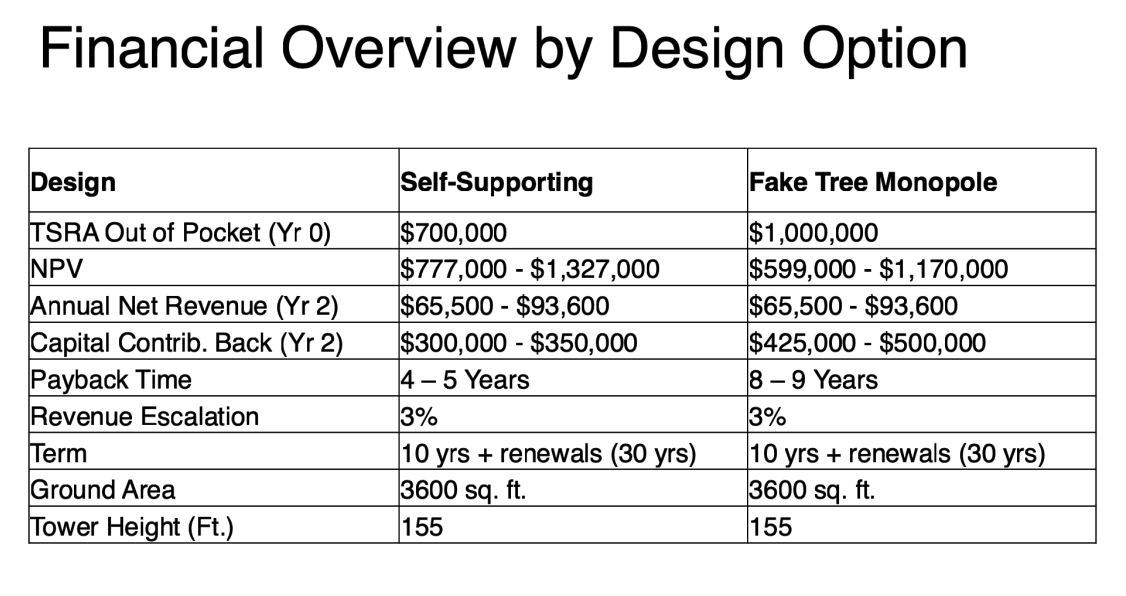
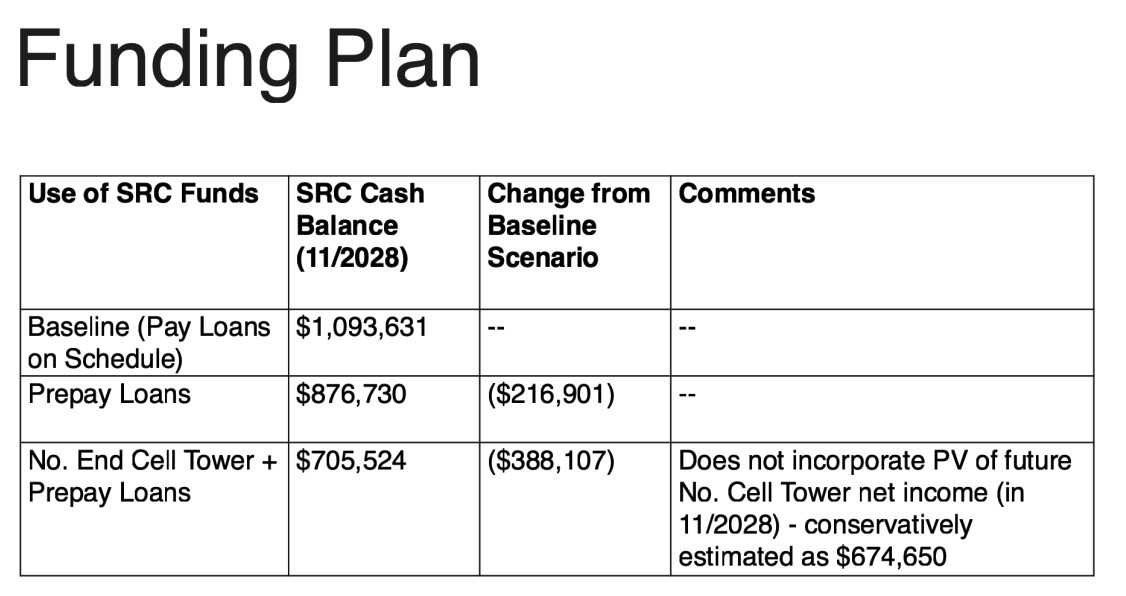
Based on the proposal discussed at the Apr 19, 2025 Finance committee meeting, the majority of the up front project funding would be financed with cash from the TSRA balance sheet. The cost to the Association of building the tower has been estimated by staff to be in the range of $700,000 to $1,000,000.
Independent assessment by industry experts indicate that there is a high potential risk of cost over-run, especially considering uncertainty in steel and other tariffs impacting the cost of industrial construction. If the permitting process requires a “fake tree” tower design the costs will be higher because the plastic branches have to be replaced every +/- 7 years.
The detailed financial modeling used to justify the project has not been shared with members, so it is difficult to independently assess the assumptions and financial risk. It is almost certain that the aggregate decrease in property values for neighboring properties (who are also co-owners of the Sea Ranch commons land) HAS NOT been included in the analysis. There is also an alarming lack of detail in what has been shared regarding the costs of:
Road construction to the site.
Tariffs on steel and other construction costs.
Necessary parking space to accommodate tower construction heavy equipment, tenant communications equipment maintenance, and future antenna upgrading activities;
Site clearing and preparation for the 3,600 square foot foundation;
Trenching and running the fiber optic backhaul from the west to the east side under Highway One, if necessary;
Trenching and running electric power to the site;
Construction of up to 4 on-site buildings;
Recurring increased maintenance costs; and
Unforeseen legal expenses during the permitting process.
Once the tower is built, the shared study estimates the best case scenario for annual revenue potential to be $93.6k (again, unclear what assumptions have been made about tenant occupancy or lease rates). That equates to less than $4 per month per Sea Ranch household (assuming 2000 dues paying members).
For these reasons, it is the view of those in this coalition that the project is based on an uncertain financial cost/benefit analysis, and sets a wrong precedent of relatively low-revenue projects compared to substantial the environmental and community impacts.
Derived from the August 23, 2025 TSRA Board of Directors Agenda “North Cell Tower Presentation Packet: “Feasibility Study” Section
Flawed Member Engagement
It seems incomprehensible that the current Board -- after a 10-year hiatus concerning any TSRA north end cell tower activity—is proposing construction of a 155-foot industrial steel structure with more than 48 antennas, towering over 80 feet above the tree line located near, and visible from, residential neighborhoods, and costing upwards of $1 million -- did not realize that something more than mere Board referrals to the Finance Committee for financial reviews and a regular Board meeting, is sufficient to provide adequate member notification and engagement for considering a project of this scale.
This is especially so, given that the project will negatively and irreparably alter the character of The Sea Ranch. The erection of such a huge edifice near to, and in plain sight of, member’s homes is completely out-of-sync with preserving the character of our natural environment -- which is the reason we all came to live here in the first place.
The process of member engagement for this project is disconcerting given the Board’s generally:
ignoring the facts that this is the first major construction project taken on by TSRA that is so vertically imposing and out of sync with the environmental setting, located in plain view of many members’ homes, and that simply fails to conform to the covenant we have all agreed to uphold;
lacking an assessment of members’ current cell coverage needs, and instead chasing the promise of cell carrier lease payments;
lacking transparency as to the rigor of any financial modeling assumptions;
unilaterally zero-in on the Dog Park site 4 to 6 months before 5 “potential” tower sites were vetted at a Board meeting;
being unwilling to refer the project to the Planning Committee in spite of 170 Association members who, to date, have signed a petition asking the Board to do so;
failing to consider the effects of the tower on property values and member quality of life;
failing to communicate the ramifications and risks to TSRA of cell carrier lease and non-disclosure contracts;
failing to communicate the implications of cell carriers’ future needs/desires for multiple towers/antennas on The Sea Ranch; and
failing to consider the potential human health and wildlife effects of long-term exposure to low-level electromagnetic radiation (for human effects see here and here, for wildlife effects see here and here).
Key Concerns Identified by Community Members
Precedent Setting
The Sea Ranch’s founding design approach of preserving the indigenous landscape and endowing it with a superior status to the human-built environment is at risk. The Board’s current proposal for a 155 ft. cell tower, with approximately 80 feet of steel and up to 48 antennas that will be visible ABOVE the tree line; in clear sight of many members’ homes (along parts of Deer Trail, Leeward, Sea Stack, Helm, Del Mar Pt., Solstice, Tide Pool, Foremast and beyond) and from Del Mar Center/pool; and in close geographical and visual proximity to Highway 1 and the Bluff Trail will arguably constitute a failure of TSRA to conform to this guiding principle.
Environmental & Landscape Impact
The proposed tower would rise far above the surrounding tree line, making it visible from nearby homes, trails, and key public viewpoints. The industrial steel structure would fundamentally alter the character of a naturally preserved area that has been intentionally protected for over half a century. The site sits at the gateway to the north end, where the landscape is defined by quiet forest, wildlife habitat, and views that reflect The Sea Ranch’s core principles of “living lightly on the land,” which is the very reason many in The Sea Ranch membership have decided to make it their home.
Visual Impacts & Quality of Life
A cell tower constructed near the dog park will have an outsized negative impact on the quality of life for community members. Construction of this industrial infrastructure will require significant tree removal to accommodate an access road for construction and maintenance, the tower itself, and an expected (propane-fueled according to the feasibility study) backup generator, which will be turned on every week for approximately 15 minutes to test. These factors will impact natural habitats, contribute to visual blight in the middle of our community, impact existing trails, and add noise pollution and fire risk. Depending on FAA requirements, it may also require a light at the top of the tower, adding light pollution.
Lack of Transparent Need Assessment
TSRA has not provided members with any objective, data-driven assessment of actual cell service gaps or the severity of the problem. Despite repeated requests, no engineering reports, independent analyses, or coverage maps have been published for community review. Instead, the project has advanced behind-the-scenes, without member input, on vague assertions rather than transparent evidence. When a long-term, high-impact infrastructure project is proposed without first establishing a clear, validated problem statement, it signals a breakdown in process and deepens the sense that member input is being sidelined—further eroding trust in the Association’s decision-making.
Use of Member Funds
TSRA plans to use the Sea Ranch balance sheet to fund the project, without a member vote. These are member-derived funds, and their use reflects long-term priorities for the Association. Rather than committing this money to a single, high-impact capital project with substantial controversy, TSRA could choose to allocate these reserves to other pressing needs—such as long-deferred water system upgrades, road maintenance, fire safety investments, or other projects that benefit the entire community. Alternatively, the Association could preserve this capital by placing it in lower-risk investments to strengthen TSRA’s financial position for future needs.
The decision to direct these funds toward a 155-foot tower, without input from the membership, raises important questions about transparency, governance, and whether this reflects the community’s actual priorities.
Uncertain Business Model
It is unclear if the tower will produce enough revenue to justify TRSA’s investment as well as the community impact. According to TSRA’s projections, the net revenue (revenue minus operating costs) from the tower, in the best case scenario (fully leased, within budget, etc.), would be sufficient to reduce the monthly HOA dues by less than $3.80, or by ~1% of the $380 in dues we are paying now. Furthermore, the construction of the tower – which TRSA would fund based on planned models – will set a wrong precedent of undertaking relatively low-revenue projects relative to their environmental and community impacts. Additionally, some homeowners closest to the site are at risk of losing $100-150K or maybe even more in property values.
If a Legitimate Public Safety Issue, Why is it TSRA’s Responsibility?
TSRA members should not incur the cost, impact, and long-term responsibility of maintaining communication infrastructure that is funded through the state. It was stated during the August 2025 board meeting that the land-mobile radio (LMR) backhaul that connects CAL FIRE operations in our area is insufficient. CAL FIRE maintains its own statewide public-safety communication networks, including VHF channels and microwave backhaul, funded and managed by the State of California. Their 2024–25 budget exceeds $4.2 billion, $2.8 billion from the State General Fund, which includes allocations for communication infrastructure, including crew radios and comm tablets. Specifically, a $21 million statewide project to upgrade telecommunications facilities (towers, vaults, repeaters, and microwave links) is funded through the General Fund (CA Dept. of Finance BCP).
Have We Earnestly Evaluated Other Location Options?
While TSRA presented a set of site alternatives at the August Board of Directors meeting, many members believe this comparison was not conducted in earnest. The timeline clearly indicates that the Dog Park site had already been selected for feasibility work well before those “options” were publicly introduced, suggesting that the evaluation may have been more of a formality than a genuine review.
Equally concerning, key factors that directly affect members—such as environmental impact, neighborhood well-being, visual intrusion, and potential effects on property values—were not meaningfully included in the site assessment criteria. Without transparent, criteria-driven analysis that fully weighs community impacts, members cannot trust that the least harmful or most appropriate location was ever seriously considered.
Have We Explored Other Technology Solutions?
New advancements in technology must be thoroughly considered as alternatives before committing to a permanent tower in our community. As mentioned by community members during the August 2025 Board meeting, handset satellite communication, mesh networks, and switching carriers could improve coverage without environmental impact. It's unclear if updates/upgrades to existing infrastructure have been earnestly explored as alternatives.
What’s at Risk with the Project as Proposed?
This project does not affect just one neighborhood near the Dog Park. It affects all of The Sea Ranch, and every Association member. As proposed by the Board, it threatens the spirit, values, and beliefs embodied in a covenant that we have all agreed to support by virtue of our purchase of property, which endows The Sea Ranch with its special sense of place.
All Association members agreed to uphold a principle that sustains “… the character of the natural environment in which their property is located, and accept…the principle that the development and use of The Sea Ranch must preserve that character for its present and future enjoyment by other owners. …[And] it is also assumed that those who are entrusted with the administration of The Sea Ranch will discharge their trust in full recognition of that principle….” (The Sea Ranch Restrictions, p. 6)
This is what is at stake, and currently at-risk, with this huge industrial project. It only takes four Board members to get the Sea Ranch in the “cell tower business,” leaving the rest of us in the dark as to the consequences of their actions for the future. It appears the Board’s vision is elevating revenue generation above preserving the character of the environment. This would be a dramatic realignment of the ethos of The Sea Ranch, and needs to be thoroughly and transparently revealed to members.
By seemingly placing revenue as the primary focus, the Board is free to pursue any financial endeavors, including cell towers, data centers, and whatever other opportunity it chooses as long as their bottom line shows profit. And given the manner in which this Board has proceeded along those lines to date, no factual data is required for justification.
Chair Fulkerson argues that the Board has openly provided members with adequate notification of the Dog Park Cell Tower Project and has welcomed homeowner input. Not only has the Board unilaterally selected the tower location site, denied members’ request for referral to the Planning Committee for open discussions and fact finding, provided no data-driven facts to support their claims, it also seems to expect members to accept their conclusions without question. And all the while gaslighting some in the membership by insisting “it’s early, nothing has been decided,” when the evidence suggests otherwise.
Members are concerned that the Board is fast-tracking this project and, if successful, will leave homeowners living with the consequences for decades to come. The Board has substantially failed to transparently reveal their revenue generation vision for The Sea Ranch.
Before they proceed, members need a clear understanding of this “new vision” in light of the covenant we have collectively agreed to uphold. A covenant which has served to make The Sea Ranch the vanishingly rare place that it is today.